
AI answering services for Australian businesses
Planning a new system or switching provider?
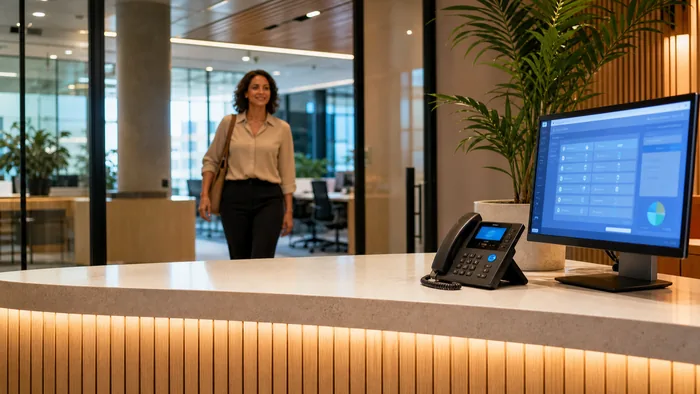
An AI answering service picks up your phone when nobody can, works out what the caller wants from ordinary speech, and either deals with it or passes it to a person.
This page covers what one actually does, where it earns its place, where it does not, and the four decisions that make the difference between a caller being helped and a caller hanging up. We install and support business phone systems, and this is something we can build into yours. Nothing here is gated.
What an AI answering service actually does
Software answers the call. The caller talks normally instead of pressing numbers, and the system works out what they are ringing about.
What it can do from there, once it has been set up properly:
- Answer the questions you have given it answers to. Opening hours, where you are, whether you cover a suburb, whether a job is booked in.
- Take a message and put it somewhere useful. An email, a text, or straight into whatever system your team already watches.
- Book, move or confirm an appointment against a real calendar rather than a list somebody types up later.
- Collect what you need to quote. Name, site, what has gone wrong, how urgent it is.
- Hand the call to the right person, and pass on what it has already been told so the caller does not start again.
The difference from an answering machine is that the caller gets somewhere. The difference from a person is that it only knows what you have told it, which is why most of the work in setting one up is deciding what it is allowed to say.
An auto attendant is not the same thing
Worth separating these two, because a lot of businesses ask us for the second and need the first.
An auto attendant is the menu. Press one for service, press two for accounts. It has been on business phone systems for decades, it is built into most current systems rather than being anything new, and it is completely predictable. It does exactly what you configured and nothing else.
An AI answering service is the one that listens. No menu. The caller says what they want and the system decides what to do about it.
Try the cheap one first. A well built auto attendant, with proper after hours rules and a voicemail that reaches somebody, solves a good share of what people come to us wanting AI for, and it is already sitting in the system you have. There is more on that in what an auto attendant is actually worth.
If you try that and the calls are still going unanswered, then the AI question is a real one.
Where it earns its place
- Calls arrive while nobody is free to take them. A trade on a roof, a clinic mid consultation, a workshop with the compressor running.
- After hours and weekends, where the alternative is a voicemail nobody leaves.
- A small number of questions asked constantly. Where are you, are you open, do you come out this far, is my part in yet.
- Busy runs you cannot staff for. The Monday morning after a long weekend does not justify another person, and it does lose calls.
The test is simple. If you are sending callers to voicemail today and they are not leaving one, an automated answer is better than what you have now. If somebody picks up on the second ring today, it is not.
Where it does not, and we would rather say so before you buy one
- Callers with complicated problems. If most of your calls are existing customers halfway through something, an automated answer is an obstacle. They will press zero, and they will be annoyed by the time they reach anybody.
- Callers who are upset. Send those to a person quickly and do not make them explain themselves twice.
- A business that is short staffed. It answers faster. It does not do the work. If the queue is really a resourcing problem, this moves the queue rather than clearing it.
- Work sold on judgement or trust. If the first voice a new client hears is software, some of them will not ring back, and you will never know which.
- Noisy lines and unfamiliar accents. It mishears. So does a person, but a person notices they have misheard, and this is exactly why the handover below matters more than the software.

How it attaches to the system you already have
It sits in front of your phone system rather than replacing it. Your handsets, extensions and numbers stay exactly as they are.
You choose when it answers, and that choice matters more than which product you pick. The usual three:
- After hours only. Everything in business hours rings the desks as it does now.
- Only when nobody picks up. It answers on the fifteenth second rather than the first, so a caller who would have got a person still gets one.
- Everything, all the time. Rare, and it suits a business where the phone genuinely cannot be answered.
The systems we install support this shape, including Yeastar and 3CX. If you are on something else, tell us what it is and we will tell you whether it can do this. Where the system itself lives, in your building or in a data centre, is covered on the hosted PBX page, and the wider picture is on business VoIP systems.
The handover is what decides whether it works
Almost every bad experience with an automated answer comes down to the same thing, and it is not the software failing to understand the caller. It is what happens after it cannot help.
Four things to settle before anybody configures anything:
- What it does when it does not know. Naming a person and saying when they will ring back is a service. Saying it did not understand, three times, is not.
- How a caller reaches a human immediately, and that it works every single time. Say the word, press the key, and it goes through.
- Where the message actually lands, and who is responsible for it. A message in a mailbox nobody owns is a lost call with a paper trail.
- What happens if the handover fails. Nobody free, out of hours, phones down. Ring a mobile, or take a message and send the transcript with it.
Write those four down first. They are the service. The software is the easy part.
What it should be allowed to say
Keep it narrow. Give it the ten questions you actually get, and let it hand over everything else.
The expensive fault is confidence. A system that invents an answer about your prices, your lead times or what is covered under warranty is worse than one that says somebody will call back, because a caller believes it and you find out later. Anything that commits you to a price, a date or a repair should come from a person.
A greeting that says what it is costs you nothing. Most callers work it out in a sentence anyway, and being told up front that an assistant is taking the call, and that a person is there if they want one, is the difference between clever and evasive.
Recordings, transcripts and summaries
An AI answering service produces a record by design. It usually keeps a transcript of what the caller said, and often a written summary of the call.
The rules on recording a call, and on what you may keep afterwards, are not the same in every state, and they are not something a phone company should be advising you on. Ask your own adviser what applies to you.
What we can tell you is what the system does once you have decided. Recording can be off entirely, on for some extensions and not others, or announced at the start of a call. Transcripts and summaries can be kept or discarded. Access can be limited to named people. Those are settings, and they should be set on purpose rather than left on whatever they arrived as.
There is more on the practical side of that in AI call summaries, convenience or compliance risk.
What it costs
We do not publish a price for this, for the same reason we do not publish one for a phone system: what you pay depends on how much of your calling it handles and what it has to connect to.
What moves the number is how many calls it answers, whether it only works after hours or all day, and whether it has to talk to a calendar or a job system rather than just take a message. The shape of a phone system bill generally, and what a quote will not show you unless you ask, is set out on what a VoIP system actually costs.
Before you ask us about one
Three things make the conversation useful, and none of them are technical:
- What your callers actually ring for. The top three is enough.
- What happens to those calls now, in hours and out of them.
- Who should get the message once it has been taken.
With those we can tell you whether an AI answer helps, whether a better auto attendant and a sensible after hours rule would do the same job, or whether the honest answer is that you need another person. We will say the third one if it is true.
Call 1300 865 879, or send us the details and we will come back to you.
Common questions
- Is an AI answering service the same as an auto attendant?
- No. An auto attendant is the menu that asks you to press one for service, and it does exactly what it was configured to do. An AI answering service listens to what the caller says instead and decides what to do about it. Most current systems have an auto attendant built in, so it is worth setting that one up properly before deciding you need anything cleverer.
- Can a caller still get through to a real person?
- Yes, and it should be the first thing you set up rather than the last. Decide what a caller says or presses to reach somebody, make sure it works every time, and decide what happens if nobody is free. Most complaints about automated answering are about that path being missing, not about the software.
- Will callers know they are talking to software?
- Most of them will work it out inside a sentence, so it is better to say so in the greeting. Telling a caller that an assistant is taking the call, and that a person is available if they would rather, costs nothing and stops the conversation starting badly.
- Do we have to change our phone system to use one?
- Usually not. It sits in front of the system you already have rather than replacing it, so your handsets, extensions and numbers stay as they are. Tell us what you are running now and we will tell you whether it can do this.
- Can it only answer after hours?
- Yes, and that is usually the sensible place to start. It can answer everything outside business hours, or answer only when nobody has picked up within a set number of seconds, so callers who would have reached a person still do.
- What happens when it mishears somebody?
- It should hand over rather than guess. A system that asks the caller to repeat themselves twice and then takes a wrong message is worse than one that says a person will ring back. That behaviour is a setting, and it is worth deciding before it goes live.
- Will it record our calls?
- That depends on how it is set up, and whether you should record is a question for your own adviser rather than for us, because the rules are not the same in every state. What we can tell you is what the system does once you have decided. Recording and transcripts can be off, on for some extensions only, or announced at the start of the call, and access can be limited to named people.