
Phone systems for pharmacies
Planning a new system or switching provider?

A pharmacy phone rings all day, and a large share of those calls are the same question. This page is about answering that question without taking a pharmacist off the dispensary bench, and about the calls you genuinely cannot afford to miss underneath it.
The call that comes in a hundred times a day
Is my script ready. In most pharmacies it is the highest volume call there is and close to the lowest value one, and it tends to arrive while somebody is being served at the counter.
The usual answer is that whoever is nearest picks it up, walks to the dispensary, checks, walks back and answers. That is a minute or two of a trained person, several dozen times a day, and it happens at exactly the moments the shop is busiest.
A phone system does not make the question go away. What it does is stop the question landing on whoever is closest to the phone, which is the part that actually costs you.
Getting the pharmacist off the phone
Three things do most of the work here, and none of them is exotic.
- A menu that answers first and sends script enquiries to one place, so they stop interrupting the counter
- A queue, so four people ringing at once hear that they are waiting rather than a busy tone or a phone nobody reaches
- A recorded message that answers the questions with fixed answers, opening hours and whether you deliver, before a person is involved at all
The measure of whether it worked is not how modern the phones look. It is whether the pharmacist is interrupted less often, and that is worth checking a month afterwards rather than assuming.
The counter, the dispensary and the phone that is always in the wrong place
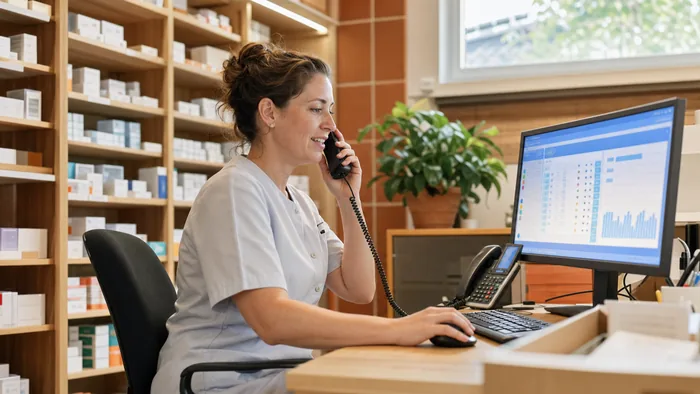
A pharmacy is a small space with several jobs happening in it, and the phone is rarely where the person who should answer it is standing.
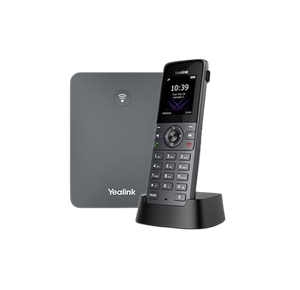
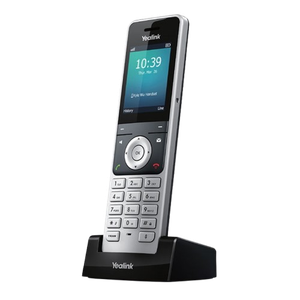
The fix is usually cordless rather than more desk phones. A cordless handset moves with the person, so a call taken at the counter can be carried to the dispensary to check something instead of the caller being put on hold while somebody walks away.
How many bases a shop needs depends on its size and its walls rather than on a number in a brochure. The trade-offs are on our DECT and cordless page.
Handsets for the counter and the dispensary
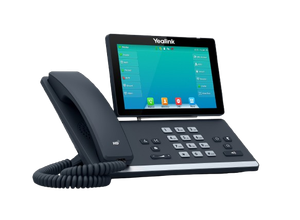
A touchscreen at the counter where the calls land, and a cordless that goes with you to the dispensary and the shop floor. Prices exclude GST.
Prescribers, wholesalers and the calls you cannot miss
Underneath the volume there is a small number of calls that matter a great deal. A prescriber ringing back about a query. A wholesaler about a supply problem. Another pharmacy chasing stock for a patient who needs it today.
Those calls are indistinguishable from the script enquiries until somebody answers them, which is the argument for a menu rather than against one. A caller who can press a number to reach the dispensary directly gets through, while the routine traffic queues behind a different option.
It is also worth having a number that reaches you when the shop line is engaged. A prescriber who gets a busy tone usually does not ring twice.
After hours, and the message that saves somebody a trip
The recorded message that plays when you are shut is doing more work in a pharmacy than in most businesses, because a caller who does not get an answer may well get in a car.
Worth saying in it: when you open, whether you are open on the weekend, and where the nearest after hours pharmacy is. That last one costs you nothing and it is the reason somebody remembers you kindly.
What we do, and what we are not
We are VoIP System. We are Australian, we are independent of every manufacturer, and business phone systems are the whole of what we do.
We are not a pharmacy software company and we have no view on how you run your dispensary. What we can do is make the phone stop being the thing that interrupts it.
We are not one of the manufacturers whose equipment we install, and we are not a partner, reseller or authorised agent of any of them.
Talk to us about your pharmacy
Tell us how many people are usually on the floor, whether you have more than one shop, and roughly what share of your calls are script enquiries. That is enough to tell you what would change at the counter.
Call 1300 865 879, or send us the details and we will come back to you.
Common questions
- Can the phone tell somebody whether their script is ready?
- Not on its own, because that answer lives in your dispensary software rather than in the phone system. What the phone can do is stop that call interrupting the counter: route it to one place, queue it when several arrive at once, and answer the fixed questions with a recorded message first.
- Do we need cordless handsets?
- Most pharmacies are better off with at least one. The phone is rarely where the person who should answer it is standing, and a cordless handset means a call can be carried to the dispensary instead of the caller being parked on hold.
- What happens when four people ring at once?
- On an older setup, usually a busy tone, and you never learn it happened. A queue holds them, tells them they are waiting, and can report afterwards how often it occurs and at what time of day, which is normally the useful part.
- Can a prescriber get through when the main line is busy?
- Yes, if it is set up that way. A menu option or a direct number can reach the dispensary while routine calls queue elsewhere. It is worth doing, because somebody ringing about a clinical query rarely rings back after a busy tone.
- We have more than one shop. Can they share a system?
- Yes, and it is usually the better arrangement. One system across both means staff dial a short extension to reach the other shop, calls can overflow from one to the other when it is busy, and there is one bill rather than two.